
I really wish that we could afford for either my husband or I to stay home with our children but if one of us stayed home we wouldn't be able to afford our house payment. We don't live in luxery - our home is a 1300 sq ft ranch with 3 bedrooms and a basement. We couldn't get anything cheaper unless we lived in an apartment (and that wouldn't be much cheaper). What happed to the days when a mother could stay home with her little ones?
-
Kari
10/12/2007 Filed Chapter 7 11/08/2007 341 Meeting 01/07/2008 Last Day for Objections
http://www.bankruptisnormal.com/ -
In Southern Cal there was some SERIOUS predatory lending and yes there are a record # of foreclosures.Originally posted by midleman View Post
You wrote:Originally posted by midleman View Post
"Of course if you live in California or some other state where RE values are outrageous you may not get much for that same $900. "
Are you kidding? What you mean is "You CANNOT GET ANYTHING FOR THAT SAME $900 a month!"
You can't even RENT a place for $900! You can't even rent a one bedroom apt. for $900 anywhere near Los Angeles! (or probably Pasadena either)
You cannot buy ANY home worth living in (half-way decent neighborhood, half-way decent house that needs work) for less than $350k. My friend paid $500k for a CONDO in Long Beach, and though it sounds like it would be, it's not anywhere near an actual beach, nor is it that great of an area, and it's 45 min. from Los Angeles! And, it's just a normal run of the mill condo, not a great place with all kinds of great features - just a normal 2 bedroom condo which is a glorified apartment.
Maybe the "American Dream" exists if you want to live in a cold, snowy state (and I'm not putting that down, it's just that some of us can't handle it; I wish I could) but if you want to live in a place with better weather, you can't do it unless you can afford around $2000/month or more in mortgage payments. That's a bare minimum, most are more like $2500-3000/month for a 2br or 3br home in a half way decent neighborhood.
Crackerbox houses with tiny 12x15 bedrooms and tiny kitchens and tiny living rooms on my block are selling for $375,000. I wouldn't even live in one of them, the neighbors are so close on top of them, why bother? You may as well rent an apt...
American Dream? In California? You'd better have two incomes of at least $120k total and that's going to be very tight. More like $150k to do it without suffering a lot.Last edited by PaKettle; 03-01-2008, 07:14 PM.<<I am NOT an attorney, my comments are anecdotal only. Contact an attorney for advice>>
FINALLY DISCHARGED 92 DAYS AFTER THE 341!A NEW START!!!Comment
-
Well said, Pa. My neighbor here pays 1800.00 per month trnt and told me he was happy to find it. Some of you have seen H/cane pics of my place, you know it ain't fancy."You once asked me for advice. You want some now? Never pass up a good thing." Lieutenant Jean Rasczak, Starship Troopers
Join the Mobile Infantry and save the world. Service guarantees citizenship.Comment
-
The only way you could get something for 900/mth(where I live at) would be to go in with roommates to rent something or rent a bedroom in someone's house. You can even rent a garage for about 500-600/mth.Originally posted by PaKettle View Post
Houses for sale start at 1.5 mil and that is a small house in the alley probably.
If you wanted to rent a 3 bedroom, it would be anywhere from 2800-3600/mth and that isn't that big. Some places go for 6000/mth.Last edited by Cali; 03-02-2008, 07:19 AM.Comment
-
Renting in California is rough anyways.Trying to get some [URL Removed] for my problems.Comment
-
If renting is rough, buying is rougher!Originally posted by fred333 View Post<<I am NOT an attorney, my comments are anecdotal only. Contact an attorney for advice>>
FINALLY DISCHARGED 92 DAYS AFTER THE 341!A NEW START!!!Comment
-
AMEN, PaKettle!!!!!!!!!!!!!!!! Owning is far more expensive!!!!!!!!!!!!!!!!!!!!!!!!!"You once asked me for advice. You want some now? Never pass up a good thing." Lieutenant Jean Rasczak, Starship Troopers
Join the Mobile Infantry and save the world. Service guarantees citizenship.Comment
-
Anything & everything is rough today!Comment
-
guess we'd better stay here in Charlotte, NC... things are rough (so I hear, have only always rented) but a coworker of mine who earns about $30k (a bit under that, actually) who is a single mother just bought a 3/2 house in what is a fairly decent neighborhood... convenient location, houses about 10-12 yrs old, shopping and highway nearby, and she swears her credit sucks. loan through BofA, too, no special programs that I know of. we rent a 2/2 duplex with a huge basement and deck in a NICE neighborhood (houses go for $300k + which is considered big nice houses here) for $800 but I know we're lucky to have found it. I am pretty scared of owning a house actually! the repairs, no flexibility if we wanted to move fast for whatever reason... I personally wouldn't get much from the feeling of, "but I own it - it's mine!" because um... no, not really... the bank owns it! for what, 15-30 yrs? yikes! I'll be happy to rent for anther few years until we're more stable financially and can be 110% sure of the area and type of loan we feel comfortable with.... and that may be never, who knows?!Monica
planning to file Ch. 7 - soon!
Comment
-
That's true, everything is a battle, and nothing seems right in this country. It's still probably the best place to live, but it's hard to keep faith in the American dream when so many things are now stacked up against the average citizen.Originally posted by BKOnce View PostHi, I'm new here.
(Link Removed By Moderator)Comment
-
Are you living in the constitution free zone?
Since the title of this thread is "The American Dream no longer exists. ", I thought the following is best posted here. Makes me sick...
ARE YOU LIVING IN THE CONSTITUTION FREE ZONE?

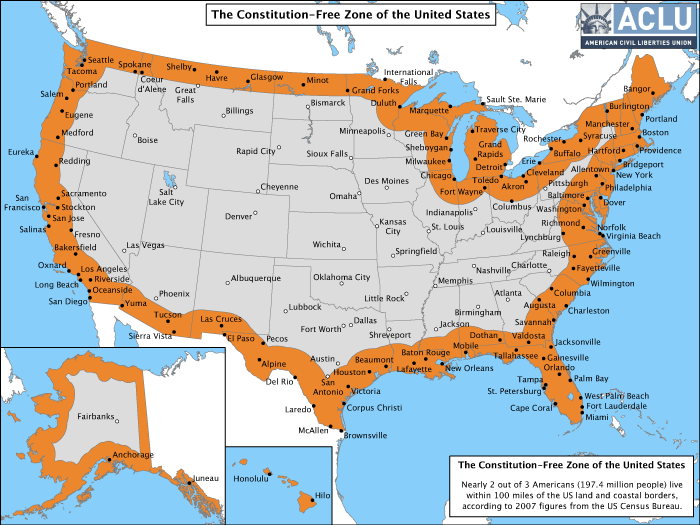
Fact Sheet on U.S. "Constitution Free Zone"
The problem
Normally under the Fourth Amendment of the U.S. Constitution, the American people are not generally subject to random and arbitrary stops and searches.
The border, however, has always been an exception. There, the longstanding view is that the normal rules do not apply. For example the authorities do not need a warrant or probable cause to conduct a "routine search."
But what is "the border"? According to the government, it is a 100-mile wide strip that wraps around the "external boundary" of the United States.
As a result of this claimed authority, individuals who are far away from the border, American citizens traveling from one place in America to another, are being stopped and harassed in ways that our Constitution does not permit.
Border Patrol has been setting up checkpoints inland-on highways in states such as California, Texas and Arizona, and at ferry terminals in Washington State. Typically, the agents ask drivers and passengers about their citizenship. Unfortunately, our courts so far have permitted these kinds of checkpoints-legally speaking, they are "administrative" stops that are permitted only for the specific purpose of protecting the nation's borders. They cannot become general drug-search or other law enforcement efforts.
However, these stops by Border Patrol agents are not remaining confined to that border security purpose. On the roads of California and elsewhere in the nation -places far removed from the actual border-agents are stopping, interrogating, and searching Americans on an everyday basis with absolutely no suspicion of wrongdoing.
The bottom line is that the extraordinary authorities that the government possesses at the border are spilling into regular American streets.
Much of U.S. population affected
Many Americans and Washington policymakers believe that this is a problem confined to the San Diego-Tijuana border or the dusty sands of Arizona or Texas, but these powers stretch far inland across the United States.
To calculate what proportion of the U.S. population is affected by these powers, the ACLU created a map and spreadsheet showing the population and population centers that lie within 100 miles of any ?external boundary? of the United States.
The population estimates were calculated by examining the most recent US census numbers for all counties within 100 miles of these borders. Using numbers from the Population Distribution Branch of the US Census Bureau, we were able to estimate both the total number and a state-by-state population breakdown. The custom map was created with help from a map expert at World Sites Atlas.
What we found is that fully TWO-THIRDS of the United States? population lives within this Constitution-free or Constitution-lite Zone. That?s 197.4 million people who live within 100 miles of the US land and coastal borders.
Nine of the top 10 largest metropolitan areas as determined by the 2000 census, fall within the Constitution-free Zone. (The only exception is #9, Dallas-Fort Worth. ) Some states are considered to lie completely within the zone: Connecticut, Delaware, Florida, Hawaii, Maine, Massachusetts, New Hampshire, New Jersey, New York, Rhode Island and Vermont.
Part of a broader problem
The spread of border-search powers inland is part of a broad expansion of border powers with the potential to affect the lives of ordinary Americans who have never left their own country.
It coincides with the development of numerous border technologies, including watch list and database systems such as the Automated Targeting System (ATS) traveler risk assessment program, identity and tracking systems such as electronic (RFID) passports, the Western Hemisphere Travel Initiative (WHTI), and intrusive technological schemes such as the Secure Border Initiative Network (SBINet) or virtual border fence? and unmanned aerial vehicles (aka "drone aircraft").
This illegitimate expansion of the extraordinary powers of agents at the border is also part of a general trend we have seen over the past 8 years of an untrammeled, heedless expansion of police and national security powers without regard to the effect on innocent Americans.
This trend is also typical of the Bush Administration's dragnet approach to law enforcement and national security. Instead of intelligent, competent, targeted efforts to stop terrorism, illegal immigration, and other crimes, what we have been seeing in area after area is an approach that turns us all into suspects. This approach seeks to sift through the entire U.S. population in the hopes of encountering the rare individual whom the authorities have a legitimate interest in.
If the current generation of Americans does not challenge this creeping (and sometimes galloping) expansion of federal powers over the individual through the rationale of "border protection," we are not doing our part to keep alive the rights and freedoms that we inherited, and will soon find that we have lost some or all of their right to go about their business, and travel around inside their own country, without interference from the authorities.Comment
-
ACLU Assails 100-Mile Border Zone as "constitution-Free"
Government agents should not have the right to stop and question Americans anywhere without suspicion within 100 miles of the border, the American Civil Liberties Union said Wednesday, pointing attention to the little known power of the federal government to set up immigration checkpoints far from the nation's border lines.
The government has long been able to search people entering and exiting the country without need to say why, which is known as the border search exception of the Fourth Amendment.
After 9/11, Congress gave the Department of Homeland Security the right to use some of its powers deeper within the country, and now DHS has set up at least 33 internal checkpoints where they stop people, question them and ask them to prove citizenship, according to the ACLU.
"It is a classic example of law enforcement powers expanding far beyond their proper boundaries ? in this case, literally,? said Caroline Fredrickson, who heads the ACLU's Washington, D.C., Legislative Office.
The ACLU says it has scores of complaints from citizens and wants Congress to investigate and roll back the buffer zone. According to a map the rights group released Wednesday, some 190 million citizens live within what the ACLU dubs the "Constitution-free Zone."
DHS spokesman Jason Ciliberti says the ACLU's description of the zone as "Constitution-Free" couldn't be further from the truth and that the check points follow rules set by Supreme Court rulings.
"We don't have the abilitty to just set up checkpoints willy-nilly," Ciliberti said. "The Supreme Court has determined that brief investigative encontuers do not constitute a serach or seizure."
When citizens or visa holders encounter a checkpoint, most are waived on after showing identification, but if an agent suspects the person is not lawfully in the country, the agent can detain the person until the agent's investigation is satisfied.
The government has long had the power to set up such check points, but has recently expanded the number of permanent and 'tactical' check points and deployed them in areas they hadn't before -- such as near the Canadian border.
The courts, however, are not on the ACLU's side ? and have regularly ruled that the Fourth Amendment's protections don't extend to the border area, airport screening or even to laptops at the border.
In a video shown to reporters at a national press conference event Wednesday, retired San Diego social worker Vince Peppard complained that he and his wife were stopped at a checkpoint on a road east of San Diego on I-94, many miles after crossing back into the United States with tiles he'd bought in Mexico.
When he refused to let the Customs and Border Protection officer search his car, the officer led him to a bench, called in the contraband dog and then "ransacked" his car.
"I didn't feel like I was inside the U.S.," Peppard said, calling the search on the side of the road embarrassing. "I felt like I was in a B-movie with Nazis asking for my papers."
ACLU attorney Chris Calabrese is certain there are more people who have been negatively affected than have complained.
As an example, he cited Seattle's domestic ferries, where DHS agents ask passengers for ID to check their citizenship and use license plate readers.
"The people who live on these islands are undergoing this extra scrutiny just when they are going to get their groceries," Calabrese said.
Customs and Border Protection Cilberti's says he did not specifically look into Peppard's case, but said that refusing a search does not create probable cause for a search and that if a CBP agent searched his car, it's because their experience and training made them believe they had probable cause.
The ACLU hopes that Congress will include changes to the border zone in traveler privacy protection bills that focus on prohibiting suspicion-less searches and seizures of laptops at the border. Congress is currently out of session and would not move on any legislation until sometime in 2009 at the earliest.
Citizens' U.S. Border Crossings Tracked
Citizens' U.S. Border Crossings Tracked
Data From Checkpoints To Be Kept for 15 Years
By Ellen Nakashima
Washington Post Staff Writer
Wednesday, August 20, 2008; A01
The federal government has been using its system of border checkpoints to greatly expand a database on travelers entering the country by collecting information on all U.S. citizens crossing by land, compiling data that will be stored for 15 years and may be used in criminal and intelligence investigations.
Officials say the Border Crossing Information system, disclosed last month by the Department of Homeland Security in a Federal Register notice, is part of a broader effort to guard against terrorist threats. It also reflects the growing number of government systems containing personal information on Americans that can be shared for a broad range of law enforcement and intelligence purposes, some of which are exempt from some Privacy Act protections.
While international air passenger data has long been captured this way, Customs and Border Protection agents only this year began to log the arrivals of all U.S. citizens across land borders, through which about three-quarters of border entries occur.
The volume of people entering the country by land prevented compiling such a database until recently. But the advent of machine-readable identification documents, which the government mandates eventually for everyone crossing the border, has made gathering the information more feasible. By June, all travelers crossing land borders will need to present a machine-readable document, such as a passport or a driver's license with a radio frequency identification chip.
In January, border agents began manually entering into the database the personal information of travelers who did not have such documents.
The disclosure of the database is among a series of notices, officials say, to make DHS's data gathering more transparent. Critics say the moves exemplify efforts by the Bush administration in its final months to cement an unprecedented expansion of data gathering for national security and intelligence purposes.
The data could be used beyond determining whether a person may enter the United States. For instance, information may be shared with foreign agencies when relevant to their hiring or contracting decisions.
Public comments are being taken until Monday, when the "new system of records will be effective," the notice states.
"People expect to be checked when they enter the country and for the government to determine if they're admissible or not," said Greg Nojeim, senior counsel at the Center for Democracy & Technology. "What they don't expect is for the government to keep a record for 15 years of their comings into the country."
But DHS spokesman Russ Knocke said the retention period is justified.
"History has shown, whether you are talking about criminal or terrorist activity, that plotting, planning or even relationships among conspirators can go on for years," he said. "Basic travel records can, quite literally, help frontline officers to connect the dots."
The government states in its notice that the system was authorized by post-Sept. 11 laws, including the Enhanced Border Security and Visa Reform Act of 2002, the Aviation and Transportation Security Act of 2001, and the Intelligence Reform and Terrorism Prevention Act of 2004.
Nojeim said that though the statutes authorize the government to issue travel documents and check immigration status, he does not believe they explicitly authorize creation of the database.
"This database is, in a sense, worse than a watch list," he said. "At least in the watch-list scenario, there's some reason why the name got on the list. Here, the only thing a person does to come to the attention of DHS is to lawfully cross the border. The theory of this data collection is: Track everyone -- just in case."
Under the system, officials record name, birth date, gender, date and time of crossing, and a photo, where available, for U.S. travelers returning to the country by land, sea or air. The same information is gathered about foreign travelers, but it is held for 75 years.
DHS and other agencies are amassing more and more data that they subject to sophisticated analysis. A customs document issued last month stated that the agency does not perform data mining on border crossings to glean relationships and patterns that could signify a terrorist or law enforcement threat. But the Federal Register notice states that information may be shared with federal, state and local governments to test "new technology and systems designed to enhance border security or identify other violations of law." And the Homeland Security Act establishing the department calls for the development of data-mining tools to further the department's objectives.
That raises concerns, privacy advocates say, that analyses can be undertaken that could implicate innocent people if appropriate safeguards are not used.
The border information system will link to a new database, the Non-Federal Entity Data System, which is being set up to hold personal information about all drivers in a state's database. States that do not agree to allow customs to have such large amounts of information may allow the agency to query their databases in real time for information on a traveler.
Because of privacy concerns, Washington state earlier this year opted for the queries-only approach. The Canadian government made the same decision. "There was absolutely no way they should have the entire database," said Ann Cavoukian, Ontario's privacy commissioner, who learned about the Canadian government's decision in April.
"Once you have data in a database you don't need, it lends itself to unauthorized use," she said. "You have no idea of the data creep."
Vermont opted to allow access to its driver's licenses because the state could not guarantee the "nanoseconds" response time DHS required, said Bonnie L. Rutledge, the state's commissioner of motor vehicles. She said drivers are informed up front of the data sharing.
"A person opts to go over the border, their information is going to be collected and held anyway," she said. "If you don't want to go over the border, you don't have to."
The notice states that the government may share border records with federal, state, local, tribal or foreign government agencies in cases where customs believes the information would assist enforcement of civil or criminal laws or regulations, or if the information is relevant to a hiring decision.
They may be shared with a court or attorney in civil litigation, which could include divorce cases; with federal contractors or consultants "to accomplish an agency function related to this system of records"; with federal and foreign intelligence or counterterrorism agencies if there is a threat to national or international security or to assist in anti-terrorism efforts; or with the news media and the public "when there exists a legitimate public interest in the disclosure of the information."
Homeland Security is proposing to exempt the database from some provisions of the 1974 Privacy Act, including the right of a citizen to know whether a law enforcement or intelligence agency has requested his or her records and the right to sue for access and correction in those disclosures.
A traveler may, however, request access to records based on documents he or she presented at the border.
The notice is posted at the Government Printing Office's Web site.Comment
-
You're driving along a remote, dusty road, when suddenly you come upon a border patrol checkpoint. There, agents demand to see your identity papers, and search your car. You are taken by surprise, because you know you haven?t wandered across the Texas-Mexico border. In fact, you?re quite sure of that, because you?re driving through rural Wisconsin countryside west of Green Bay. Even the Canadian border is more than 90 miles away.
This scene is not as far-fetched as you might want to believe. The government is turning vast swaths of our country into a "Constitution-Free Zone" in which U.S. Customs and Border Protection (CBP) is allowed to exercise extraordinary authority that would not normally be permitted under the Constitution. The government says that "the border"- where there is a longstanding view that the Constitution does not fully apply- actually stretches 100 miles inland from the nation's "external boundary." And increasingly, we are seeing DHS vigorously utilize that authority.
Today we held a press conference at the National Press Club here in D.C. to try to draw attention to this problem ? and the fact that, as we showed, nearly two-thirds of the U.S. population live within this "Constitution-Free Zone." That?s 197.4 million people.
We calculated this using the most recent, 2007 numbers from the U.S. Census, and released a map showing the cities and states that are enveloped by this zone. It includes some of the largest metropolitan areas in the country: New York City, Boston, Chicago, Los Angeles and Portland, Oregon. States that are completely within this Constitution-Free Zone include Connecticut, Delaware, Florida, Hawaii, Maine, Massachusetts, Michigan, New Hampshire, New Jersey, and Rhode Island. When you say "border," they think "all of New England."
CBP has been setting up checkpoints far inland - on highways in states such as California, Texas and Arizona, and at ferry terminals in Washington State. Typically, the agents ask drivers and passengers about their citizenship. People are also reporting that even after they provide passports or state driver's licenses, CBP continues to interrogate them and try to pressure them into permitting a search.
At our press conference today in the National Press Club here in DC, two U.S. citizens described their experiences with CBP.
Vince Peppard, a retired social worker, told of being stopped and harassed by the border authorities at least 15 miles from the Mexico border with his wife, Berlant.
Craig Johnson, a music professor at a San Diego college, told how he participated in a peaceful demonstration near the border to protest against the destruction of a state park so that offense could be constructed along the U.S. border. CBP agents monitored the protest and collected the license plate information of those who participated. Since this protest, Mr. Johnson has twice crossed the U.S.-Mexico border and, each time, he has been pulled aside for additional screening. He was taken to another room, handcuffed and questioned. On his first crossing, he was also partially stripped and subjected to a body cavity search. A CBP agent also told Mr. Johnson that he was on an "armed and dangerous" list. Before the protest, Mr. Johnson crossed the U.S.-Mexico border numerous times without incident. It is difficult to believe that his subsequent harassment at the border is unrelated to his protest activity. If it is related, that would constitute a significant abuse.
Congress needs to hold hearings to investigate these egregious violations of Americans? civil liberties, and then pass new laws protecting Americans? rights.
I guarantee you that if these powers are not challenged, if the American people do not push back, sooner or later a factory worker in southern New Hampshire, a farmer in the Shenandoah Valley of Virginia, or yes, some guy driving across rural Wisconsin, will wake up to find that they have lost their right to go about their business, and travel around inside their own country, without interference from the authorities.Comment
-
Lake Michigan lies entirely within the borders of the United States. The other Great Lakes are shared with Canada. That means all of Illinois and most of Wisconsin are not within this 100 mile border. Otherwise I think this whole thing is silly; doesn't the ACLU have better things to worry about. Homeland Security can detain and search you anywhere they want, just like any law enforcement agency or military force can do.
What's the point? Is this a lame attempt to eliminate border security?“When fascism comes to America, it’ll be wrapped in a flag and carrying a cross” — Sinclair LewisComment
-
i swear to god (if there is a god) the united states just keeps getting dumber & dumber...and to think there are people who will sit there and say it is ok to have unconstitutional borders (constitution FREE *sounds better*!!...the only thing that protects the people.I guarantee you that if these powers are not challenged, if the American people do not push back, sooner or later a factory worker in southern New Hampshire, a farmer in the Shenandoah Valley of Virginia, or yes, some guy driving across rural Wisconsin, will wake up to find that they have lost their right to go about their business, and travel around inside their own country, without interference from the authorities.Comment
Comment